Clasificación y jerarquización de las Ciencias por su veracidad, certeza y fiabilidad

Introducción

La clasificación de las ciencias según su veracidad, certeza y fiabilidad permite comprender mejor la naturaleza de cada disciplina y sus métodos de investigación. Es fundamental destacar que esta jerarquización no implica que unas ciencias sean más importantes que otras, sino que sus características y alcances varían.

Es importante considerar la perspectiva desde la que se realiza esta clasificación. Existen diversos enfoques filosóficos y metodológicos que pueden influir en la categorización de las ciencias, y este es un tema en constante debate sin una respuesta única o definitiva.
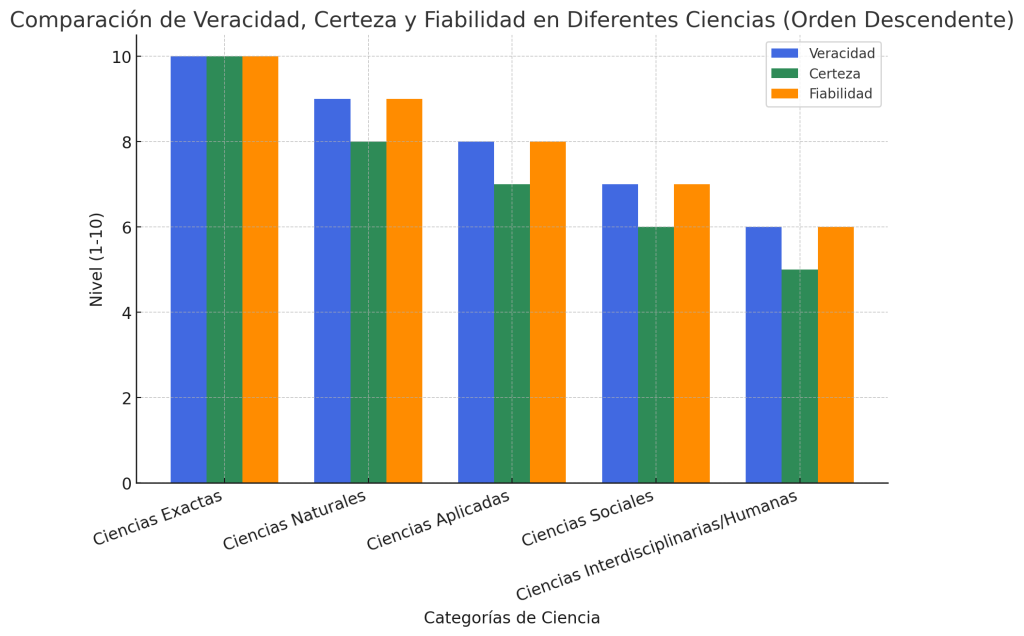

1. Ciencias exactas (o formales)

Definición

Las ciencias exactas, también conocidas como ciencias formales, se basan en el razonamiento lógico y matemático para estudiar sistemas abstractos. Se caracterizan por su precisión y la obtención de resultados demostrables.

Validez de sus postulados y teorías

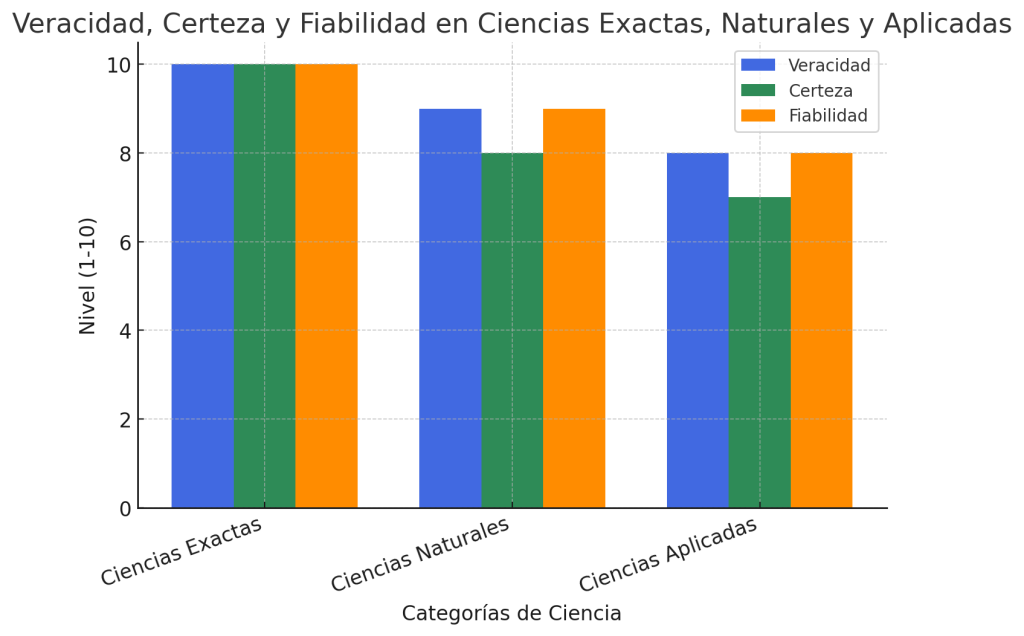
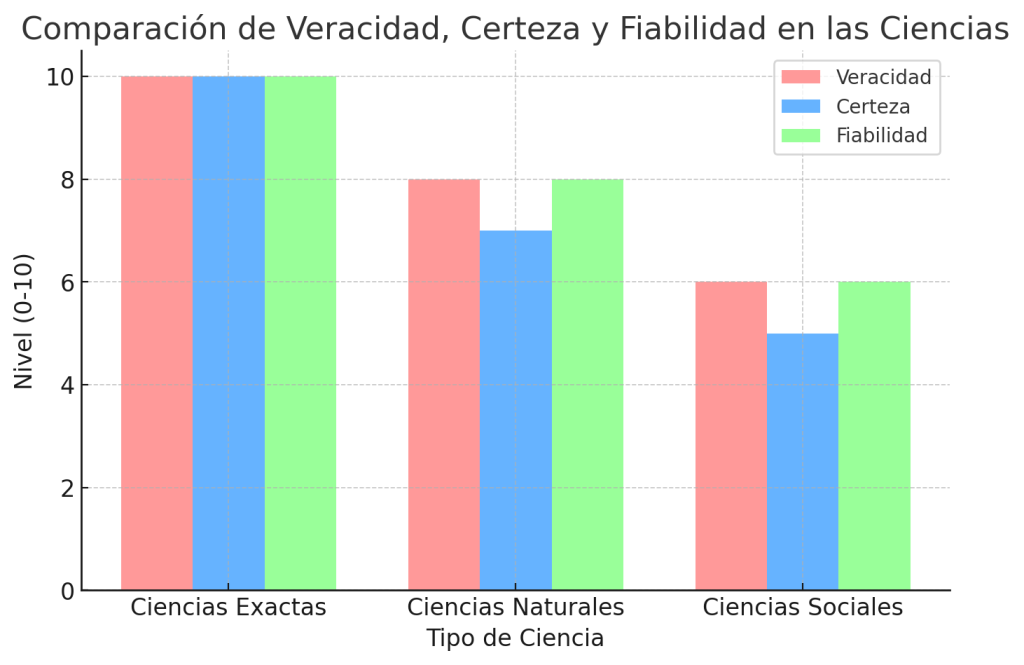
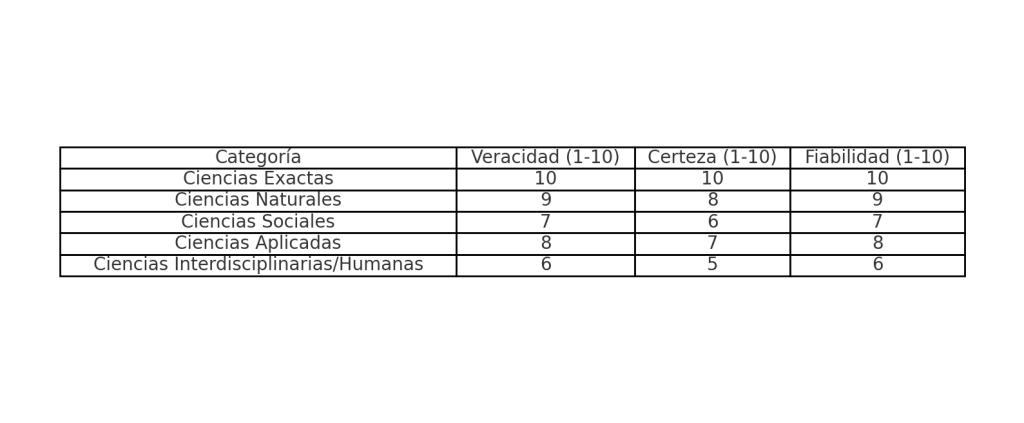
  • Veracidad: Sus postulados se derivan de axiomas y reglas lógicas, lo que les confiere una veracidad intrínseca dentro de su sistema.
  • Certeza: La demostración matemática proporciona un alto grado de certeza a sus resultados.
  • Fiabilidad: Sus conclusiones son replicables y universales dentro del marco de sus axiomas.

Ejemplos

Matemáticas, lógica, ciencias de la computación teórica.

Aclaración: La computación tiene una parte que pertenece a las ciencias formales (teoría de la computación, algoritmos), mientras que su aplicación en el desarrollo de software o la inteligencia artificial se considera una ciencia aplicada.


2. Ciencias naturales (o fácticas naturales)

Definición

Las ciencias naturales estudian los fenómenos del mundo natural mediante la observación, la experimentación y la formulación de leyes y teorías.

Validez de sus postulados y teorías

  • Veracidad: Se basan en el método científico, lo que permite la verificación empírica de sus postulados.
  • Certeza: Sus teorías están sujetas a revisión y modificación a medida que se obtienen nuevas evidencias.
  • Fiabilidad: La replicación de experimentos y observaciones es fundamental para su fiabilidad.

Ejemplos

Física, química, biología, astronomía, geología.


3. Ciencias aplicadas

Definición

Las ciencias aplicadas utilizan conocimientos de las ciencias exactas y naturales para resolver problemas prácticos y desarrollar tecnologías.

Validez de sus postulados y teorías

  • Veracidad: Se fundamentan en principios científicos comprobados, pero su efectividad depende de la aplicación y el contexto.
  • Certeza: Menor que en las ciencias naturales, ya que pueden verse afectadas por limitaciones tecnológicas o de implementación.
  • Fiabilidad: Alta en condiciones controladas, pero variable en aplicaciones del mundo real.

Ejemplos

Ingeniería, medicina, farmacología, biotecnología, arquitectura, inteligencia artificial.

4. Ciencias sociales (o fácticas sociales)

Definición

Las ciencias sociales estudian el comportamiento humano, las sociedades y sus interacciones, utilizando métodos cualitativos y cuantitativos.

Validez de sus postulados y teorías

  • Veracidad: Depende del contexto y la complejidad del comportamiento humano.
  • Certeza: Sus resultados son probabilísticos y están influenciados por factores culturales, históricos y sociales.
  • Fiabilidad: Se busca a través de la triangulación de métodos y la consideración de múltiples perspectivas.

Ejemplos

Sociología, antropología, economía, psicología, ciencias políticas, historia.

Aclaración: La historia es una ciencia social, aunque utiliza métodos de investigación particulares que combinan análisis cualitativo y cuantitativo.

5. Ciencias interdisciplinarias y humanas

Definición

Existen disciplinas que combinan métodos de varias ciencias o que tienen un enfoque más interpretativo que empírico.

Validez de sus postulados y teorías

  • Veracidad: Depende del método utilizado y del campo específico de estudio.
  • Certeza: Variable, ya que algunas disciplinas buscan explicar fenómenos con herramientas cuantitativas (como la bioinformática) y otras se basan en análisis subjetivos (como la filosofía).
  • Fiabilidad: Se construye a partir del consenso académico y la validez de los argumentos utilizados.

Ejemplos

  • Interdisciplinarias: Psicología cognitiva (ciencias naturales + sociales), bioinformática (ciencias exactas + naturales), economía matemática (ciencias exactas + sociales).
  • Humanas: Filosofía, historia del arte, literatura, lingüística, estudios culturales.

Aclaración: Las humanidades se diferencian de las ciencias sociales en que no siempre buscan explicar fenómenos mediante métodos cuantitativos, sino a través del análisis crítico e interpretativo.

Fuentes Académicas y Filosóficas:

  • Filosofía de la Ciencia:
    • Libros de Karl Popper, Thomas Kuhn y Imre Lakatos: Estos filósofos han realizado contribuciones fundamentales a la comprensión de la naturaleza de la ciencia, su metodología y sus límites.
    • «La estructura de las revoluciones científicas» de Thomas S. Kuhn: Un clásico que explora cómo cambian las teorías científicas a lo largo del tiempo.
    • «Lógica de la investigación científica» de Karl R. Popper: Un trabajo influyente sobre el método científico y la falsabilidad.
  • Epistemología:
    • Te recomendamos leer textos sobre epistemología general: Estos te ayudarán a comprender los fundamentos del conocimiento y cómo se justifica.
    • Textos que hablen sobre el positivismo lógico.
    • «Los problemas de la filosofía» (The Problems of Philosophy, 1912):Este libro es una introducción clásica a la epistemología. Russell explora cuestiones fundamentales sobre el conocimiento, la percepción, la realidad y la justificación de nuestras creencias.En este texto, Russell examina la distinción entre conocimiento «por familiaridad» y conocimiento «por descripción», que es una de sus contribuciones más importantes a la teoría del conocimiento.

Textos Clásicos y Fundamentales:

  • «La estructura de las revoluciones científicas» de Thomas S. Kuhn:
    • Este libro es esencial para comprender cómo cambian las teorías científicas a lo largo del tiempo y cómo se producen las «revoluciones científicas». Kuhn introduce el concepto de «paradigmas» y cómo estos influyen en la forma en que los científicos ven el mundo.
  • «Lógica de la investigación científica» de Karl R. Popper:
    • Popper es conocido por su teoría de la «falsabilidad», que sostiene que una teoría científica debe ser susceptible de ser refutada por la evidencia empírica. Este libro explora el método científico y los criterios para distinguir la ciencia de la pseudociencia.
  • «El positivismo lógico» de Rudolf Carnap, Moritz Schlick y Otto Neurath:
    • Este movimiento filosófico del siglo XX influyó fuertemente en la forma en que se entiende la ciencia. Sus textos exploran la relación entre el lenguaje, la lógica y la experiencia empírica.

Textos Modernos y Enfoques Actuales:

  • «Filosofía de la ciencia» de Samir Okasha:
    • Este libro ofrece una introducción clara y accesible a los principales temas y debates en la filosofía de la ciencia, incluyendo la naturaleza de la explicación científica, la confirmación de teorías y el realismo científico.
  • «¿Qué es esa cosa llamada ciencia?» de Alan Chalmers:
    • Este libro ofrece una vision de la filosofía de la ciencia, y da a conocer diferentes puntos de vista que hay sobre la misma.

Recursos en Línea:


Comentarios

24 respuestas a «Clasificación y jerarquización de las Ciencias por su veracidad, certeza y fiabilidad»

  1. I know this if off topic but I’m looking into starting my own weblog
    and was curious what all is required to get setup?
    I’m assuming having a blog like yours would cost a pretty penny?

    I’m not very web smart so I’m not 100% sure. Any suggestions or advice would be greatly appreciated.
    Kudos

    1. Avatar de Jorge Hernán Valencia Londoño
      Jorge Hernán Valencia Londoño

      Hi, of course I can give you a couple of tips, about the content and the technology path. Regarding the content, study, study what you’re passionate about. I’m not necessarily talking about professional studies, but any learning method, especially courses… and write about what you’re learning. Regarding the form, don’t set extremely high goals, don’t try to write the best post, just do it. You’ll inevitably improve over time and the result will eventually be the quality you want, but don’t let fear of doing it wrong stop you. Regarding the path, don’t be illogical. Don’t listen to those who speak ill of one technology or another; use what’s available to you. All technology is good as long as it helps you get the job done. I started working with Blogger, and Blogger is great because its editor allows you to experiment a lot with code, making it a very complete tool and a fantastic way to get started. I’m a software developer, so most of what I do involves small systems with pure code. But if you want something like this website, always consider WordPress as your first option. WordPress is free and allows you to install some basic templates that usually include an editor, which, although limited, is enough to get started. Then you can put what you learned in Blogger into practice, since the editors usually include a code component. Here, I’m not paying for an advanced, paid editor like Elementor; the default editor and the injection of pure code components are sufficient for me. And to answer your question about starting, NO, the work is in learning things, but once you know how to do it, it’s very easy and doesn’t require a large investment or much time. As for money, I only spend $125 (annually) on domain and hosting.

  2. Hello there, I believe your web site may be having browser compatibility problems.
    When I take a look at your site in Safari, it looks fine but
    when opening in Internet Explorer, it has some overlapping issues.
    I simply wanted to provide you with a quick heads up!
    Aside from that, wonderful blog!

    1. Avatar de Jorge Hernán Valencia Londoño
      Jorge Hernán Valencia Londoño

      Thanks for the feedback. I’ll note it down and then review and correct it at my leisure. I have several sites to review and update, and quite a bit of technical debt on several of them, so it might take a little time. It’s going on the integration list 😬. Thanks again for the information.

  3. I have learn a few good stuff here. Certainly price bookmarking for revisiting.
    I wonder how so much effort you set to create this type of wonderful informative website.

    1. Avatar de Jorge Hernán Valencia Londoño
      Jorge Hernán Valencia Londoño

      Thank you very much. Actually, this is a site I haven’t dedicated much time to. The content is just a small part of the study material I work with, and the blog is more of a way to share at least some of that material so it doesn’t all just become archived documents. I apply one of the principles of the ADDIE methodology in my life, which involves continuous learning, so I’m always studying something and writing reports and documents. Here, I only share what I think might be of general interest or immediately useful to those who, for example, are working on their own reports; but I haven’t yet decided to publish more specialized academic content.

  4. Somebody necessarily lend a hand to make seriously articles I would state.
    This is the very first time I frequented your web page
    and to this point? I surprised with the analysis you made to make this particular post amazing.
    Wonderful job!

    1. Avatar de Jorge Hernán Valencia Londoño
      Jorge Hernán Valencia Londoño

      Thank you, if you need help with any related issue, please don’t hesitate to ask.

  5. I think that what you posted was actually very
    reasonable. However, think on this, suppose you wrote
    a catchier post title? I am not suggesting your content isn’t solid, however what if you added something that grabbed folk’s attention? I mean Clasificación y jerarquización de
    las Ciencias por su veracidad, certeza y fiabilidad – Editorial FAD Filigrana is
    a little plain. You should peek at Yahoo’s front page and see how they create post titles to grab viewers to click.
    You might add a related video or a picture or two to grab people interested about everything’ve
    written. In my opinion, it would make your blog a little
    bit more interesting.

    1. Avatar de Jorge Hernán Valencia Londoño
      Jorge Hernán Valencia Londoño

      I understand what you’re saying; my SEO tool cries every day because of how I ignore it. It turns out I don’t write what I think people want to read or to grab the attention of a larger audience. I write what I want to share and what I think might be useful. Regarding the idea that the content I create is a bit bland, it turns out I have a lot of fun. On an average day, I might be welding, then wood carving, then reading about pedagogical models, or developing an app to replace a paid service on the educational platform I’m building. I have a lot of fun. Even so, the general consensus among people who somewhat know me is that I’m very bland. I raised a boy who’s now an adult, and he doesn’t see me or talk to me because he finds me boring. He literally told me that, that I’m very boring. But I insist that I have a great time. You understand, not everyone is there to entertain you or seem funny. Some of us are simply who we want to be and we’re happy with that.

  6. Hello! Someone in my Myspace group shared this website with us
    so I came to look it over. I’m definitely loving the information.
    I’m book-marking and will be tweeting this to my
    followers! Wonderful blog and amazing style and design.

  7. What’s up to all, how is everything, I think every one is getting more from this web site, and your
    views are nice in favor of new viewers.

  8. This piece of writing is really a good one it assists new
    the web viewers, who are wishing for blogging.

  9. obviously like your web-site however you need to check the spelling on quite a few
    of your posts. Several of them are rife with spelling problems and I in finding it very
    troublesome to tell the reality on the other hand I will definitely
    come back again.

  10. Hey there would you mind sharing which blog platform you’re working with?

    I’m looking to start my own blog soon but I’m having a difficult time choosing between BlogEngine/Wordpress/B2evolution and Drupal.
    The reason I ask is because your design seems different
    then most blogs and I’m looking for something unique. P.S Sorry for being off-topic but I had to ask!

    1. Hola, yo he usado de todo, desde páginas creadas desde cero con código puro o simples plantillas, hasta CMS como Joomla y ERP como Dolibar, y te diría que vayas a lo seguro, hay mucha gente que habla mal de WordPress, algunos dicen que es inseguro porque es la plataforma que recibe más ataques, pero esto ocurre porque es la plataforma que se usa en más sitios web en el mundo. WordPress es ideal porque te sirve no solo como gestor de contenidos, sino que tiene un entorno para E-commerce muy estable y con acceso desde cualquier parte del mundo. Ahora que si prefieres no usar WordPress para una web o un blog, entonces es preferible iniciar un desarrollo propio con código puro, que perder el tiempo con otras plataformas, y para E-commerce, la única alternativa realmente confiable es Prestashop.

      Entiéndase que no existen limitaciones de lo que puedes hacer, puedes crear algo con WordPress y combinarlo con secciones de código puro o con otras herramientas, incluso puedes tener un Prestashop dentro de una página de WordPress…

      Pero para no extenderme más y no enredarte, te sugiero que para ir a la segura, partas de una instalación de WordPress. Esto te permitirá trabajar de forma gratuita con algunas plantillas y un editor básico (prueba qué plantillas tienen editores que te resulten cómodos) y no necesitarás tener grandes conocimientos para empezar, luego puedes ir creando subdirectorios probando otras herramientas o con código puro, a medida que vayas adquiriendo experiencia; pero empieza ya mismo instalando una versión de WordPress.

  11. There is definately a lot to find out about this topic.
    I love all of the points you’ve made.

    1. Muchos gracias por tu comentario.

  12. What’s up mates, how is everything, and what you would like to say concerning this post, in my view its really amazing
    for me.

  13. Hi it’s me, I am also visiting this web site daily, this site is in fact pleasant and
    the viewers are truly sharing nice thoughts.

  14. Normally I do not read post on blogs, but I wish to say that
    this write-up very compelled me to try and do it! Your
    writing taste has been amazed me. Thanks, very great article.

  15. My brother recommended I might like this web site. He
    was totally right. This post actually made my day. You cann’t imagine simply how much time I had spent for this info!
    Thanks!

Deja una respuesta

Tu dirección de correo electrónico no será publicada. Los campos obligatorios están marcados con *